
Eliza Merrett’s Long Aftermath
The Surgeon of CrowthorneThis thread follows Eliza Merrett from the sudden destruction of her household through a tentative relationship with the imprisoned man responsible and the gradual fading of her family’s public memory.
increasing Bearing strength in each event
 decreasing
Bearing strength in each eventdecreasingA Household in Lambeth
A Family on Narrow Means
Before the shooting
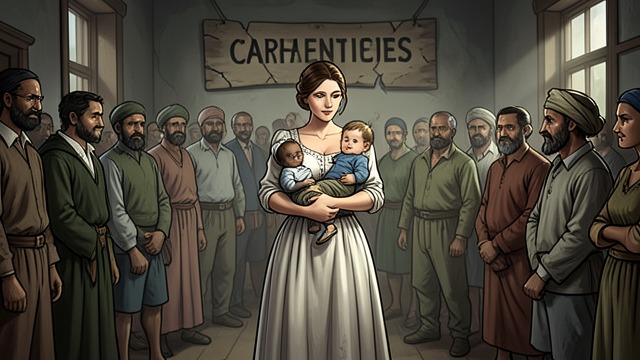
Eliza Merrett shared a crowded home in Lambeth with her husband, George, and their six children; another child was expected. George earned twenty-four shillings a week as a stoker at the Red Lion Brewery, and the family had left rural work behind for the uncertain wages of the city.
Their circumstances were precarious but organized around an ordinary future: George went out to work, Eliza kept the household going, and the children depended on both parents. His early-morning walk to the brewery had become routine, making its sudden interruption all the more devastating.
A life redirected
The killing transformed a poor working family into the dependents of a public tragedy. Eliza’s pregnancy, the children’s ages, and the household’s limited resources made the loss immediate and practical as well as emotional.
Her later connection with William Chester Minor began from this rupture, not from an abstract interest in a celebrated criminal case. The consequences of the shooting continued to shape her choices long after the newspapers had moved on.
Public Charity and Funeral
A City Responds
Relief for the widow
George’s death shocked London, and collections were organized to support Eliza and her children. Clergy in Lambeth joined efforts, and the American Consul-General opened a subscription appeal because the accused man was American.
Public attention turned the family’s private emergency into a cause for organized assistance. Donations could not restore George or remove the insecurity of a large household suddenly deprived of its wage-earner, but they offered immediate material help.
A public farewell
George belonged to the Ancient Order of Foresters, a mutual-aid society that treated his death as a responsibility to its member. Its participation gave the funeral a scale and ceremony that contrasted sharply with the family’s modest circumstances.
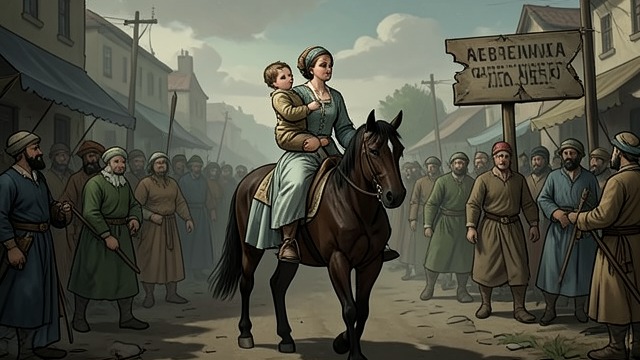
The procession passed the place where George had been shot and continued to Tooting Cemetery. Eliza rode at its head with her youngest baby, making the bereaved household visible to the thousands who followed.
An Offer of Atonement
Money and Remorse
A letter across the divide
Years after the killing, William Chester Minor wrote to Eliza through the American Embassy, expressing remorse and offering financial assistance. He understood that no payment could undo the harm, but hoped he might help the family whose lives his act had altered.
Eliza agreed to accept help and asked whether she could visit him. The request crossed an unusual boundary between a victim’s family and an incarcerated murderer, but the Home Office approved a supervised meeting after consulting the Broadmoor superintendent.
A cautious connection
Their first meeting was tense, but Eliza returned and eventually visited on a regular basis. Their conversations did not become a close friendship, yet the visits created a channel through which practical kindness and the possibility of forgiveness could coexist with the memory of the crime.
Eliza also offered to bring books from London for Minor, who was an avid collector. For a time, she carried parcels to him, joining her visits to a task that mattered greatly to his confined life.
A Family’s Uneven Legacy

The Children After George
Unequal outcomes
The assistance given to Eliza and her children did not secure them from later hardship. Eliza took to drink and eventually died of liver failure, while the family’s surviving members followed separate and often troubled paths.
One son, George, took money from Minor’s stepmother, traveled to Monaco, and styled himself the King of Monte Carlo before dying in poverty in the south of France. Another son, Frederick, died by suicide in London; the reasons were never established.
A shadow beyond the case
The book places these later losses beside the suicides of two of Minor’s relatives, widening the story’s sadness without claiming that the families’ tragedies shared a simple cause. George Merrett’s death began a chain of consequences that neither Eliza nor her children could fully escape.
These details resist the idea that the murder’s aftermath ended when the trial concluded or the public collection was made. The family’s losses continued privately, while the wider world increasingly remembered the Dictionary contributor rather than the people left behind.
The Unmarked Grave

Memory Without a Monument
Two contrasting memorials
By the time Simon Winchester reflects on the case, William Chester Minor has a marked grave in New Haven, while George Merrett’s grave at Tooting Cemetery has no surviving marker. The difference gives physical form to an imbalance in public remembrance.
Minor’s Dictionary work offers him a lasting place in a celebrated intellectual project. George, the working man whose death initiated the chain of events, has no comparable memorial to preserve his name in public life.
Restoring the victim to view
The book’s dedication becomes an act of correction: it turns attention back toward George and the family whose suffering might otherwise be reduced to background for Minor’s story. Remembering the contributor without remembering his victim would repeat the very erasure the conclusion identifies.
The contrast does not cancel Minor’s achievement or his remorse. Instead, it insists that the Dictionary’s human story includes the life cut short in Lambeth, and that an account of the remarkable must also acknowledge the ordinary person who paid its earliest cost.
Winter 1871–72
February 1872
Late 1879
Late nineteenth century to the 1920s
At the book’s closing reflection
